How gPlace works
gPlace places each query, an aligned genome, on a fixed reference tree and writes the result as a jplace file, as pplacer does. It runs pplacer’s algorithm unchanged and changes only what is kept in memory and when it is computed.
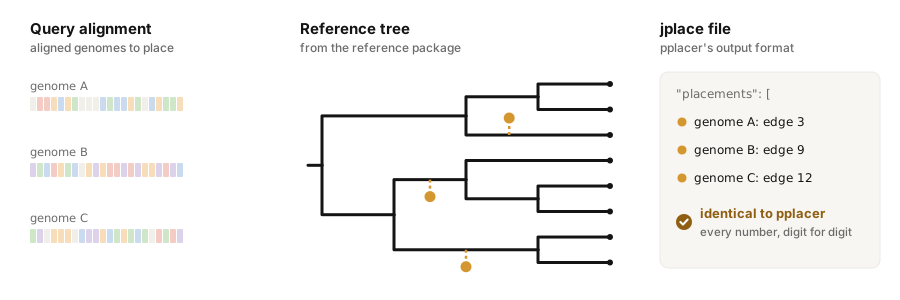
What placement produces. Each query is attached to the edge where it fits best (the orange dots); the jplace file lists, for every query, the edges kept with their likelihoods and branch lengths.
What pplacer computes
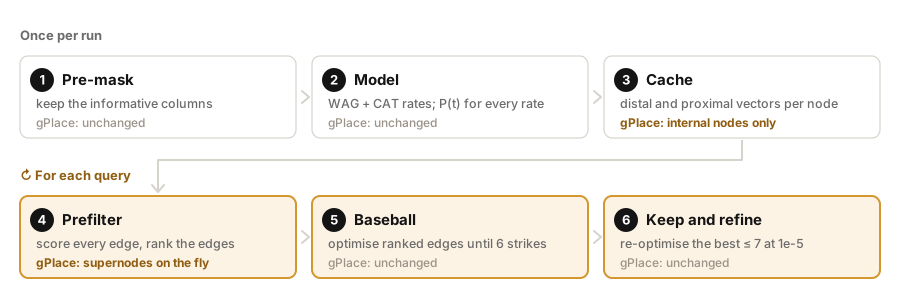
pplacer’s six steps. Steps 1 to 3 run once per reference package and steps 4 to 6 for each query. gPlace changes only the cache (step 3) and the prefilter (step 4), shown in green.
For each query, pplacer v1.1.alpha19 (pplacer -m WAG -c <refpkg>, as run by GTDB-Tk):
Pre-masks the alignment: keeps columns informative in at least one reference and one query.
Builds the model: WAG exchangeabilities and frequencies, FastTree’s 20 CAT rates and per-site categories from the refpkg; one eigendecomposition gives P(t) for every rate.
Caches likelihood vectors: for every node, a distal vector (the tree below it, post-order) and a proximal vector (the rest of the tree, pre-order), each sites x 20 doubles with per-site power-of-two exponents, plus a supernode vector for the prefilter.
Prefilters: scores the query against every edge (query evolved by 0.1, dotted with the supernode) and ranks the edges.
Baseball: fully optimises edges in ranked order (pendant and distal branch lengths, alternating GSL Brent, tolerance 0.01) until 6 edges are more than 3 log-units worse than the best so far, or 40 edges have been tried.
Keeps and refines: up to 7 edges within log(0.01) of the best are re-optimised at 1e-5; the like-weight ratios are normalised likelihoods.
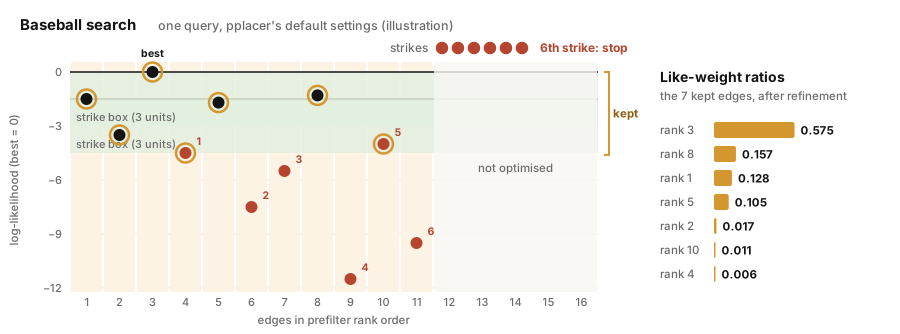
Steps 5 and 6 for one query (illustrative values). A strike is an edge more than 3 log-likelihood units below the best so far (the strike box follows the best); the search stops at the 6th strike, or after 40 edges, and the edges after it are never optimised. At most 7 edges within a factor 0.01 of the best likelihood are kept, refined and normalised into like-weight ratios.
What gPlace changes
Only what is stored and when it is computed:
distal/proximal vectors are stored for internal nodes only, before pplacer’s final “pull exponents (-10)” pass, which is re-applied to a copy when a vector is used. Rescaling by powers of two is exact, so every value is bit-identical;
leaf vectors are rebuilt on demand: a leaf’s distal vector is its sequence, and its proximal vector is its parent’s proximal vector times its siblings’ distal vectors, in pplacer’s operation order;
supernodes are computed during the prefilter, eight edges at a time, and discarded;
all queries of a reference package share one cache; a query’s result does not depend on the other queries.
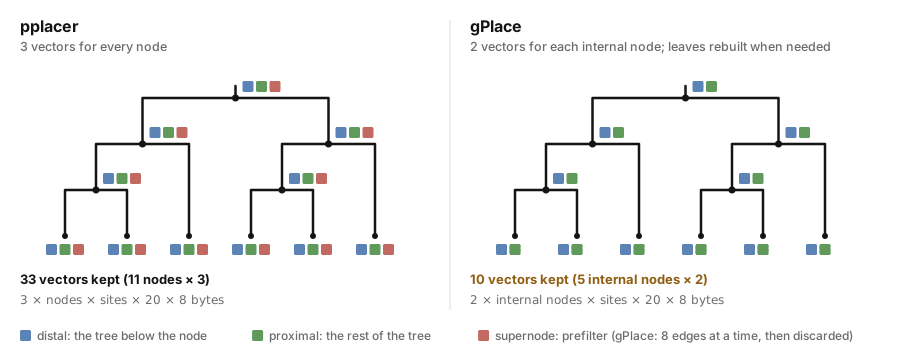
What is kept for a six-leaf tree. pplacer keeps three vectors for every node; gPlace keeps two for each internal node, rebuilds a leaf’s vectors when an edge next to it is used, and computes supernodes during the prefilter.
The memory needed drops from 3 x nodes x sites x 20 x 8 bytes to about 2 x internal nodes x sites x 20 x 8 bytes plus the prefilter scores (every query against every edge).
With --ranked_edges N there is no queries x edges score table: the prefilter scores the queries
in batches of 20,000 and each keeps only its first N ranked edges (164 covers pplacer’s default
search, which uses at most 41 successful ones), as tiled placement does. A query whose search goes
past them, after many failed optimisations, is scored against every edge again and its ranking
continues in the same order, so results are identical; memory then barely grows with the number of
queries.
Tiled placement
For trees whose vectors still do not fit (--tile_edges, --max_memory), the tree is cut
into connected tiles of at most N edges. A tile touches the rest of the tree only through
the edge above its root and the roots of the tiles below it, and everything it needs from the
outside passes through those points:
the distal vector of a tile root depends only on the tree below it: a bottom-up pass builds the tiles one at a time and stores the distal vector of each tile root;
the proximal vector of a tile root depends only on the tree outside it: a top-down pass stores the proximal vector of each tile root.
With those boundary vectors (two per tile), a tile’s vectors are rebuilt with the same operations, operands and order as the untiled cache, so every value is bit-identical, and every edge’s likelihood is a full-tree likelihood, comparable across tiles. Only one tile is in memory at a time. The cut: walking up the tree, the part of a node’s subtree not yet in a tile stays whole while it has at most N nodes; beyond that, its internal children with the largest parts become tile roots (leaves never root a tile).
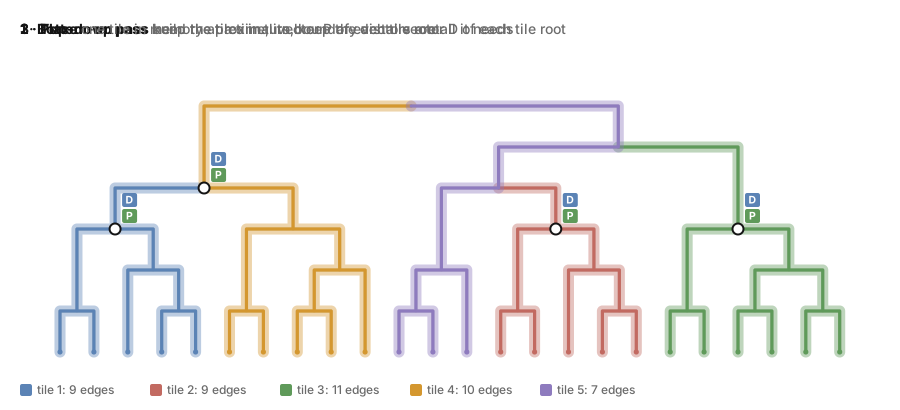
gPlace’s cut (tile_layout) of a 24-leaf tree with --tile_edges 12. With its two boundary
vectors (D and P), each tile is rebuilt on its own, exactly as in the untiled cache.
pplacer’s algorithm is unchanged; only the order of the work is:
Prefilter, tile by tile and in batches of 20,000 queries: each query keeps its 160 best edges in pplacer’s ranking order (score descending, ties by ascending edge number), which is pplacer’s global ranking without a queries x edges score table.
Baseball in rounds: each first-stage optimisation starts from pplacer’s default branch lengths, so its result does not depend on the edges tried before. The next 8 ranked edges of every query still searching are optimised, grouped by tile, and pplacer’s stopping rule is replayed on the stored results; a few extra edges are evaluated and discarded. pplacer’s search needs at most 41 successful edges; a query with many failed optimisations that runs out of candidates is re-ranked with more.
Refinement of the kept edges at 1e-5, tile by tile, then the like-weight ratios.
Each pass rebuilds the tiles, so tiled placement is 1.7-2.5x slower than untiled placement on a
tree that fits in memory; --max_memory therefore places untiled whenever it can.
Platforms
The engine is built in variants from the same C source: avx2 (x86-64; the kernels process 4
different results per instruction), neon (ARM64; 2 per instruction) and portable
(scalar loops performing the same operations in the same order; any 64-bit CPU). gPlace loads
avx2 on x86-64 CPUs that have AVX2 and FMA, neon on ARM64 and portable elsewhere. The
SIMD kernels never fuse a multiply and an add: each lane does exactly what the scalar loop does. Neither depends on the CPU’s floating-point details beyond IEEE
754 double precision: no fused multiply-add is contracted implicitly, and the only libm
functions taken from the system are exact by definition (sqrt, frexp, ldexp, and
fma for the portable engine on x86-64). On macOS
the engine is built the same way with Apple’s clang; Apple’s linker has no --defsym, so GSL’s
libm calls are bound to CORE-MATH and the traps by definitions inside the engine
(csrc/libm_bind.c) instead.
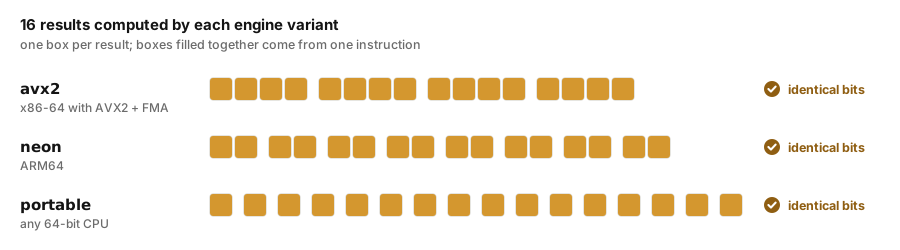
Each AVX2 instruction computes 4 different results and each NEON instruction 2, every one with the operations of the portable loop in the same order (no fused multiply-add, no reordered sum): only the speed differs.
Exactness rules
Every floating-point result keeps pplacer’s operands, operation order and rounding:
the engine (C,
gplace/engine/csrc/xp.c) mirrors pplacer’slinear_c.cloops and GSL’sdgemvloop order; SIMD lanes only process different results, no reduction is reordered, and no multiply-add is fused (-ffp-contract=off);the numerical libraries match pplacer’s statically linked binary: GSL 1.16 (GSL 2.x changes the eigendecomposition in its last bits), glibc 2.19’s
hypot(glibc >= 2.35 changed it) andlog1p(GSL’s inverse gamma CDF calls it for 21 or more gamma categories), and correctly-roundedexp/log/pow/sin(CORE-MATH gives the same results as glibc 2.19’s; GSL’s own calls in the gamma functions are bound to them as well, and no inexact system libm function is imported);GSL errors behave as in pplacer, which turns every GSL error into an exception: the optimiser’s are handled as pplacer handles them, and a GSL error while the discrete gamma rates are computed (e.g. alpha 10^6: “inverse failed to converge”) stops gPlace with pplacer’s message;
pplacer’s control-flow quirks are reproduced: the optimiser keeps the last evaluated branch lengths; the bisection start finder evaluates f(right) before f(left); an assertion failing inside a GSL callback returns NaN (ocamlgsl’s
caml_callback_exn), so GSL reports an error and pplacer retries from the default branch lengths; ties in the ranking go to the lower edge number;the jplace file prints numbers with
%.12gand writes the tree exactly asNewick_bark.to_newick_stringdoes.
Speed
The cache is built by a thread pool that starts a node as soon as its children (distal) or its
parent (proximal) are done. The prefilter and the placements run in forked worker processes; the
large arrays live in shared memory, so they are neither copied nor re-mapped per process.
Placement uses a memory-lean three-taxon kernel: the query’s evolved vectors come from a small
table of its distinct characters, and (pi x proximal) x distal is formed once per branch-length
change, with pplacer’s association.