Engine internals
How gPlace’s engine runs on different CPUs, the rules that keep every result identical to pplacer’s, and what makes it fast. How gPlace works describes what the engine computes.
Platforms
The engine is built in variants from the same C source: avx2 (x86-64; the kernels process 4
different results per instruction), neon (ARM64; 2 per instruction) and portable
(scalar loops performing the same operations in the same order; any 64-bit CPU). gPlace loads
avx2 on x86-64 CPUs that have AVX2 and FMA, neon on ARM64 and portable elsewhere. The
SIMD kernels never fuse a multiply and an add: each lane does exactly what the scalar loop does. Neither depends on the CPU’s floating-point details beyond IEEE
754 double precision: no fused multiply-add is contracted implicitly, and the only libm
functions taken from the system are exact by definition (sqrt, frexp, ldexp, and
fma for the portable engine on x86-64). On macOS
the engine is built the same way with Apple’s clang; Apple’s linker has no --defsym, so GSL’s
libm calls are bound to CORE-MATH and the traps by definitions inside the engine
(csrc/libm_bind.c) instead.
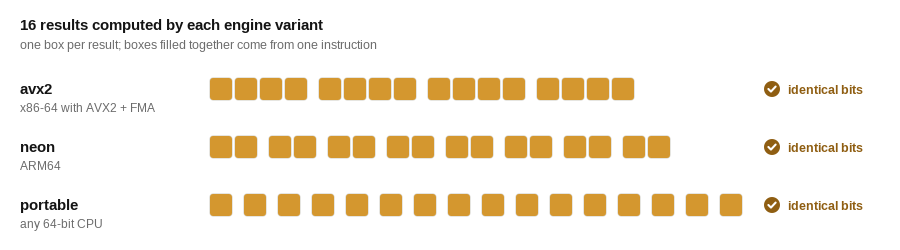
Each AVX2 instruction computes 4 different results and each NEON instruction 2, every one with the operations of the portable loop in the same order (no fused multiply-add, no reordered sum): only the speed differs.
Exactness rules
Every floating-point result keeps pplacer’s operands, operation order and rounding:
the engine (C,
gplace/engine/csrc/xp.c) mirrors pplacer’slinear_c.cloops and GSL’sdgemvloop order; SIMD lanes only process different results, no reduction is reordered, and no multiply-add is fused (-ffp-contract=off);the numerical libraries match pplacer’s statically linked binary: GSL 1.16 (GSL 2.x changes the eigendecomposition in its last bits), glibc 2.19’s
hypot(glibc >= 2.35 changed it) andlog1p(GSL’s inverse gamma CDF calls it for 21 or more gamma categories), and correctly-roundedexp/log/pow/sin(CORE-MATH gives the same results as glibc 2.19’s; GSL’s own calls in the gamma functions are bound to them as well, and no inexact system libm function is imported);GSL errors behave as in pplacer, which turns every GSL error into an exception: the optimiser’s are handled as pplacer handles them, and a GSL error while the discrete gamma rates are computed (e.g. alpha 10^6: “inverse failed to converge”) stops gPlace with pplacer’s message;
pplacer’s control-flow quirks are reproduced: the optimiser keeps the last evaluated branch lengths; the bisection start finder evaluates f(right) before f(left); an assertion failing inside a GSL callback returns NaN (ocamlgsl’s
caml_callback_exn), so GSL reports an error and pplacer retries from the default branch lengths; ties in the ranking go to the lower edge number;the jplace file prints numbers with
%.12gand writes the tree exactly asNewick_bark.to_newick_stringdoes.
Speed
The cache is built by a thread pool that starts a node as soon as its children (distal) or its
parent (proximal) are done. The prefilter and the placements run in forked worker processes; the
large arrays live in shared memory, so they are neither copied nor re-mapped per process.
Placement uses a memory-lean three-taxon kernel: the query’s evolved vectors come from a small
table of its distinct characters, and (pi x proximal) x distal is formed once per branch-length
change, with pplacer’s association.